


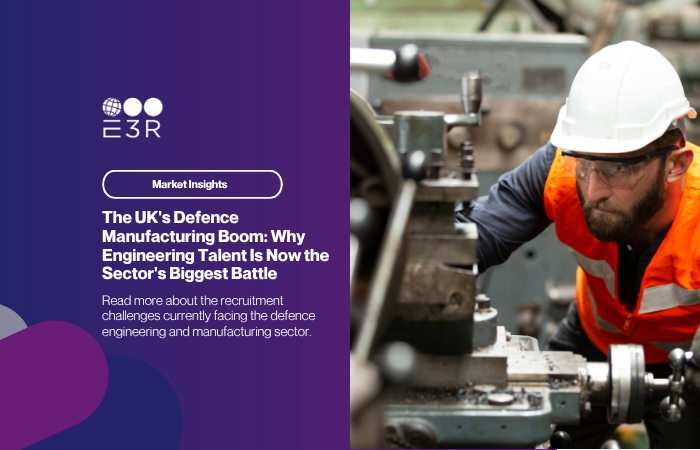
The UK’s Defence Manufacturing Boom: Why Engineering Talent Is Now the Sector’s Biggest Battle
Defence manufacturing is having a moment. Rising geopolitical tension, increased government spending commitments and a renewed focus on national resilience have pushed the sector firmly into growth mode. For engineering and manufacturing businesses operating in this space, that’s good news on paper. In practice, it’s created a talent problem that’s proving just as difficult to solve as any technical challenge on the shop floor.
A sector under pressure to deliver, fast
Defence contracts don’t come with flexible deadlines. When the Ministry of Defence, prime contractors or allied governments place an order, the expectation is delivery at pace and to exacting standards. That puts enormous pressure on manufacturers to scale up production quickly, often for highly specialised components, systems and platforms that can’t simply be outsourced overseas.
The result is a sector that needs skilled people now, not in eighteen months once a training pipeline catches up. Roles across machining, welding and fabrication, systems engineering, quality assurance and programme management are all in high demand, and many of these positions require security clearance on top of technical competence, which narrows the available pool considerably.
Why the talent pool is shrinking, not growing
The defence sector isn’t competing just against other defence manufacturers for talent. It’s competing against automotive, aerospace, renewables and general engineering, all of which are chasing the same core skill sets. Add an ageing workforce, a well documented drop in people entering engineering apprenticeships over the past decade, and the added complexity of security vetting, and you’ve got a hiring landscape that’s tighter than most business leaders would like.
Security clearance in particular is a sticking point. SC and DV clearance can take months to process, and candidates without existing clearance are often deprioritised even when they’re technically the strongest fit. That means businesses need to think further ahead than a standard recruitment campaign would usually require, building relationships with cleared or clearable candidates well before a vacancy becomes urgent.
What good defence recruitment actually looks like
Recruiting for defence manufacturing isn’t the same as filling a general engineering vacancy. It demands a genuine understanding of the sector, its terminology, its compliance requirements and the realities of clearance timelines. A recruitment partner who doesn’t understand the difference between SC and DV clearance, or who can’t speak confidently about MOD supply chain requirements, is going to slow the process down rather than speed it up.
The businesses getting this right tend to do three things well. They build a pipeline of cleared or clearable candidates ahead of need, rather than starting from scratch when a role opens. They work with recruitment partners who genuinely understand the sector rather than treating defence as just another engineering vertical. And they’re realistic about timelines, factoring clearance and vetting into their planning from day one rather than treating it as an afterthought.
Seeing it play out: David Brown Defence in Huddersfield
This isn’t a theoretical problem. E3 Recruitment is an exclusive recruitment partner to David Brown Defence, previously supporting a project with hiring over 50 skilled professionals at its Huddersfield site, including Mechanical Fitters, Cell Leaders, CNC Machinists and Design Engineers, as the business scaled up production of precision engineered gearboxes for naval and land based military platforms.
It’s a good example of exactly the pressures covered above. Roles were subject to security and export control restrictions, meaning nationality and place of birth could affect which positions a candidate was eligible for, and candidates needed to meet Right to Work and clearance requirements before they could start. Managing that alongside a fast moving, high volume campaign is where a recruitment partner with genuine sector knowledge earns its keep.
You can read more about the David Brown Defence partnership here
The opportunity for engineering businesses
Despite the challenges, this is a sector with real momentum behind it. Increased investment, long term contracts and a renewed strategic focus on domestic manufacturing capability mean defence engineering is likely to remain a growth area for years to come. For businesses that get their workforce planning right, that’s a significant opportunity rather than just a headache.
Getting there means treating recruitment as a strategic function rather than a reactive one. The businesses that build strong talent pipelines now, understand the clearance landscape, and partner with recruiters who genuinely know the sector will be the ones best placed to win and deliver the contracts on offer.
If you’re struggling to find cleared, skilled engineering talent for your defence manufacturing operation, E3 Recruitment can help – get in touch with our team to talk through your workforce challenges.
📞 01484 645269

