


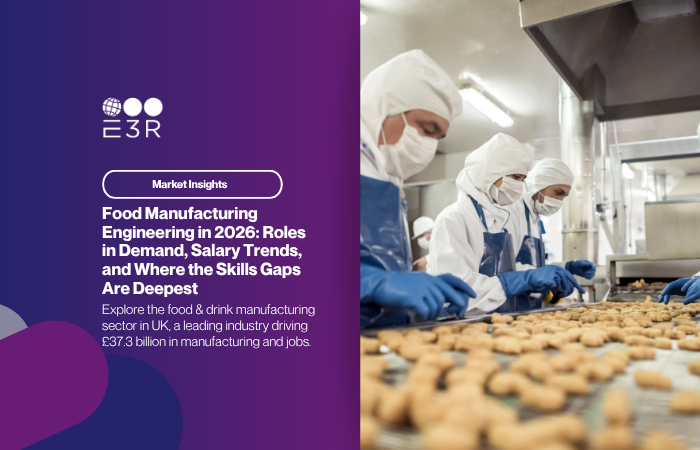
Food Manufacturing Engineering in 2026: Roles in Demand, Salary Trends, and Where the Skills Gaps Are Deepest
Britain’s food and drink manufacturing sector has long been quietly extraordinary. It is the country’s largest manufacturing industry, contributing £37.3 billion to the economy and accounting for nearly a quarter of total UK manufacturing turnover. It employs close to half a million people.
And yet, when engineers consider their careers, food rarely tops the list of destinations. That perception is shifting fast, and the engineering talent market within the sector is tightening in ways that have real consequences for both employers and professionals.
In 2026, the combination of persistent vacancy pressure, accelerating automation investment, and a shrinking pipeline of qualified candidates has created a market that rewards skilled engineers handsomely and leaves employers scrambling.
The State of the Market
The broader engineering sector has proved unusually resilient throughout recent economic uncertainty. At a time when most UK industries reduced headcount and cut back on hiring, engineering emerged as the only sector recording growth in permanent job openings. Food and drink manufacturing sits firmly within that picture.
As recruitment specialists working across the sector, we have noted steady demand throughout 2025 and into 2026 for production, engineering, technical, and leadership roles, driven primarily by ongoing skills shortages and the constant pressure on manufacturers to deliver at pace whilst remaining compliant with increasingly complex regulatory requirements.
The Numbers Are Hard to Ignore
76% of engineering employers struggle to recruit for key roles (IET, 2025)
Over 50% of food and drink companies report chronic labour shortages
Only 61% of engineering employers believe their current workforce is prepared for the future
Why This Is Structural, Not Cyclical
For food manufacturers, this is not a temporary blip. The underlying drivers are structural:
- An ageing engineering workforce, with a large cohort approaching retirement
- Reduced graduate uptake into manufacturing compared to technology and defence
- Rapid technological change raising the technical bar for existing roles
- Accelerating automation investment that demands skills the sector does not yet have in volume
EngineeringUK projects that more than 173,000 new engineers and technicians will be needed each year through 2030 to meet demand across all sectors. In food manufacturing, the pace of automation investment means that the technical bar is rising precisely as the talent pipeline narrows.
Roles in Highest Demand
1. Automation and Controls Engineers
The most acute shortage in the sector right now.
As robotics and automated systems take on an ever-greater share of production, ingredient handling, and packaging tasks, the need for engineers who can commission, programme, and maintain these systems has become critical. There is a severe shortage of qualified candidates within the food industry for automation and controls engineers with programmable logic control knowledge.
Skills employers are specifically asking for:
- PLC programming (Allen Bradley, Siemens)
- SCADA systems design and maintenance
- Robotics integration and commissioning
- Data engineering and business intelligence tools
The challenge is compounded by the sector’s own ambition. Investment in automation is accelerating, partly as a response to labour shortages and partly as a long-term productivity strategy. Yet research by Automate UK found that many food manufacturers invest in advanced systems that end up underutilised because the engineering teams available cannot fully leverage them. The technology is there. The engineers to run it are not.
2. Multiskilled Maintenance Engineers
Consistently in demand. Consistently hard to fill.
The expectation placed on maintenance engineers has grown considerably. Historically, a maintenance engineer might have been primarily electrical or primarily mechanical. Today, employers want genuine dual-skilled professionals who can combine traditional engineering expertise with digital capabilities.
What that looks like in practice:
- An electrically biased engineer with PLC programming skills
- A mechanical engineer comfortable working with automated diagnostic systems
- Someone who can cover both fault-finding on legacy equipment and commissioning of new automated lines
The shift pattern nature of the role, combined with the physical demands of food production environments, makes attracting engineers from other sectors difficult. Yet salaries have risen meaningfully, with roles regularly advertised at £45,000 to £55,000 for experienced candidates and shift premiums pushing total packages higher still.
3. Process Engineers
The engineer at the heart of operational capability.
Process engineers design and optimise the processes by which food is manufactured, troubleshoot production issues, and drive continuous improvement. As manufacturers invest in new product lines, reformulate existing products in response to nutrition labelling requirements, and respond to sustainability targets, the process engineer’s role has become more complex and more strategically important.
Demand is particularly strong in sectors experiencing rapid change:
- Ambient and chilled ready meals
- Plant-based protein production
- Functional and fortified foods
- High-care and allergen-controlled environments
Employers typically seek a background in food engineering, food science, or a related discipline alongside hands-on production experience.
4. Engineering Managers and Site Engineering Leads
Technical credibility meets commercial leadership — and this combination is rare.
Site Engineering Managers at well-run UK food businesses are now expected to combine:
- Strong technical background across mechanical and electrical disciplines
- People management across multi-shift teams
- Budget ownership and capital project oversight
- CMMS expertise and lean manufacturing knowledge
- Regulatory compliance, including BRC and food safety standards
The market for experienced Engineering Managers is extremely competitive. Candidates at this level are often not actively seeking new roles, and employers frequently rely on specialist recruiters to identify them. There is also a visible gap between capable mid-level engineers and those genuinely ready to step into leadership. Developing that pipeline internally has become a strategic priority for larger manufacturers.
5. Project Engineers and Capital Project Managers
Capital investment is flowing — but the people to deliver it are scarce.
With significant investment flowing into food manufacturing around automation, decarbonisation, and capacity expansion, there is persistent demand for project engineers and project managers who can deliver complex engineering projects on time and within budget.
These individuals must navigate food safety compliance, contractor management, and the operational realities of manufacturing sites that cannot simply stop production for refurbishment. Experience of delivering projects in live food production environments is valued significantly above general project management credentials.
Salary Trends in 2026
The Make UK Manufacturing Salary Guide 2026, compiled from data gathered from 227 manufacturing businesses between December 2025 and January 2026, provides the most current benchmarking available. Salaries across food manufacturing engineering have risen, though the increases have not been uniform.
2026 Pay Ranges at a Glance
| Role
|
Typical Range
|
Notes
|
| Graduate / Junior Engineer
|
£27,000 – £33,000
|
Broadly in line with wider manufacturing
|
| Multiskilled Maintenance Engineer
|
£40,000 – £55,000
|
Shift premiums can add significantly
|
| Automation Engineer
|
£50,000 – £65,000+
|
Higher for robotics / advanced controls
|
| Process Engineer (3–7 yrs exp.)
|
£42,000 – £58,000
|
Varies by complexity of environment
|
| Engineering Manager / Site Lead
|
£65,000 – £90,000+
|
Senior roles at major manufacturers exceed £90k
|
The specialist premium: An automation engineer with proven food sector experience and hands-on SCADA and PLC capability will command a 20–25% premium over a similarly experienced engineer without that specific background.
Regional Picture
Regional variation is significant and worth understanding:
London and South East — carry a headline premium, though the cost of living differential diminishes its practical value in disposable income terms.
The Midlands — houses a significant concentration of food manufacturing sites and has seen notable salary inflation as manufacturers compete for a limited local pool.
Northern England and Scotland — offer competitive base salaries with considerably lower living costs. Specialist recruiters note these regions are increasingly attractive to engineers willing to consider relocation.
The broader trend identified across all of UK manufacturing applies with particular force in food: the value of specific, demonstrable skills over generalist experience has never been higher. Sector knowledge, not just engineering qualification, is where the premium lies.
Where the Skills Gaps Are Deepest
1. Automation and Digital Skills
The deepest gap — and the one widening fastest.
The technologies being deployed across food manufacturing, including robotics, vision systems, industrial IoT sensors, and data analytics platforms, are not unique to the food sector. But applying them within the specific regulatory, hygiene, and operational context of food production requires a combination that very few engineers currently possess.
The data is stark:
- 30% of engineering employers say they lack sufficient automation skills internally (IET, 2025)
- Only 23% of food and beverage companies report being highly familiar with smart manufacturing concepts
- The main barriers to digital transformation in food processing: costs (44%), knowledge gaps (41%), skill deficiencies (39%)
Food manufacturing has historically been slower to adopt advanced automation than automotive or aerospace. Many sites are now investing heavily, but the engineering capability to implement and sustain those investments is not keeping pace. The knowledge gap and the skill deficiency are, at root, the same problem: there are not enough engineers who understand both the technology and the food production context.
2. Sustainability and Decarbonisation Engineering
A new expectation has arrived — and most teams are not ready for it.
Food manufacturing is a significant energy user, and the pressure to reduce carbon footprints, improve energy efficiency, and transition away from fossil fuel-dependent processes is intensifying. This is generating demand for engineers with specific competencies in:
- Energy management systems
- Refrigeration systems optimisation
- Sustainable process design and low-carbon utilities
- Carbon reporting and lifecycle analysis
The expectation that food manufacturing engineers will engage substantively with decarbonisation as part of their core role is new, not optional. Yet 36% of engineering employers believe their organisation lacks the skills to decarbonise by 2050, and sustainable manufacturing is generating dedicated engineering roles at a rate the sector’s talent supply cannot match.
3. Engineering Leadership
The quietest crisis — but arguably the most consequential.
Beneath the headline shortage of technical engineers lies a serious gap in engineering leadership. The manufacturing workforce has contracted significantly over the past two decades, and the cohort of senior engineers who entered the industry in the 1980s and 1990s is now approaching or passing retirement age. The replacement cohort is smaller, and it has developed in a period of rapid technological change that has not always been accompanied by structured leadership development.
Employers in 2026 are finding it genuinely difficult to identify candidates who combine:
- Strong technical credibility
- Commercial awareness and budget management
- Communication skills across operations, finance, and senior leadership
- Strategic thinking about workforce capability and capital planning
Those individuals who do possess that combination know exactly what they are worth — and they are negotiating accordingly.
4. Food-Specific Technical Knowledge
General manufacturing experience is common. Food expertise is not.
Engineers with strong general manufacturing backgrounds but limited food sector experience are plentiful enough. What is scarce is deep knowledge of the regulatory and technical specifics of food production:
- BRC Global Standards compliance
- HACCP principles and implementation
- Hygienic engineering design
- Allergen management within production environments
- The specific demands of chilled, frozen, or high-care manufacturing areas
Employers are willing to pay a meaningful premium for engineers who arrive with this knowledge. Many are also reporting that re-training engineers from adjacent sectors, whether automotive, broader FMCG, or pharmaceuticals, takes longer and costs more than initially anticipated.
Addressing the Gap: What Employers Are Doing
Building pipelines early. The most forward-thinking manufacturers are investing in apprenticeship programmes and early careers pipelines, recognising that waiting for the market to produce the talent they need is not a viable strategy. Several large food businesses have expanded partnerships with further education colleges and universities, embedding food manufacturing content into engineering curricula.
Rethinking interim and contract. Interim professionals have taken on a different role in this market. They are no longer simply filling temporary gaps but are leading improvement projects, commissioning new automation systems, and stabilising engineering functions during periods of change. Part-time and fractional interim arrangements, once unusual, have become mainstream.
Getting serious about benchmarking. The Make UK guide and similar tools are being used more systematically to ensure that pay structures remain competitive. In a market where candidates at mid-career level expect a substantial pay increase to move employer, those who cannot offer competitive packages are finding their shortlists shrinking.
Confronting the perception problem. There is growing recognition that food manufacturing has a perception problem with engineering graduates. It is Britain’s largest manufacturing sector. It is investing at pace in sophisticated technology. It offers engineering challenges that are genuinely complex and consequential. But it does not consistently communicate this, and it loses talent to sectors that are better at marketing their engineering credentials.
In Conclusion
Food manufacturing engineering in 2026 is a field defined by strong demand, rising salaries, and skills gaps that show no signs of resolving quickly.
For engineers with automation, controls, or process engineering backgrounds, and particularly for those who have accumulated food sector experience, this is a market that rewards both technical capability and the willingness to work in an industry that genuinely matters.
For employers, the imperative is clear: invest in the talent pipeline, benchmark pay honestly, and make the case for food manufacturing as a destination of choice for engineering talent. The sector’s scale and its rate of technological change make it an entirely credible one.
The challenge is persuading the next generation of engineers to see it that way.
For more guidance on recruitment within the sector or to learn more about our vacant roles, get in touch with our Food & Drink division:
📞 01484 645269

