


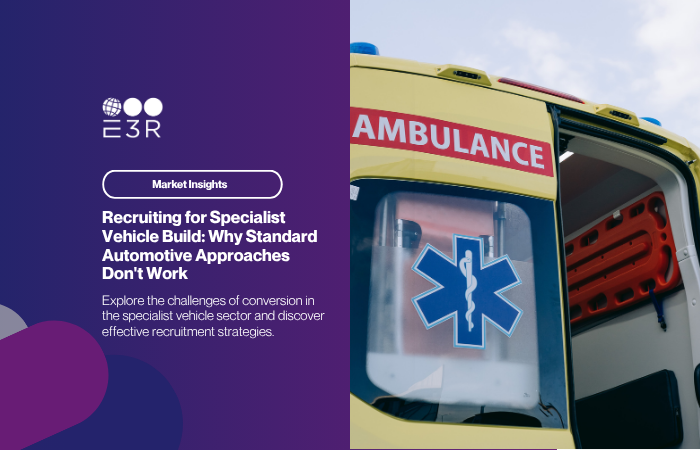
Recruiting for Specialist Vehicle Build: Why Standard Automotive Approaches Don’t Work
Demand for specialist vehicles is rising across the board. Emergency services are renewing ageing fleets, defence procurement is accelerating, and the conversion market – motorhomes, accessible vehicles, mobile units – hasn’t slowed down in years. For the businesses building these vehicles, that’s good news commercially and a genuine headache operationally, because the people who can actually build them are in desperately short supply.
The instinct for a lot of hiring managers is to treat this like any other automotive recruitment problem: post the vacancy where you’d post a production line role, look for candidates with “automotive” on their CV, and expect the usual pipeline to deliver. It doesn’t. Specialist vehicle build is a different trade wearing automotive clothing, and recruiting for it the way you’d recruit for a mainstream OEM production line consistently comes up short.
Why the standard playbook doesn’t transfer
Mainstream automotive manufacturing is built around high-volume, single-station repetition. A production operative on a car line typically masters one task, or a small handful, and performs it hundreds of times a shift. The recruitment approach that grew up around that world is optimised for exactly this: fast throughput, standardised assessment, a large and fairly interchangeable candidate pool.
Specialist vehicle build is closer to the opposite. Volumes are low, builds are often bespoke or semi-bespoke, and one person will typically work across fabrication, wiring, fitting and finishing on the same vehicle rather than repeating a single task on hundreds of them. That means you’re not hiring an operative – you’re hiring someone closer to a multi-skilled tradesperson, and there simply aren’t as many of them to go round.
The candidate pool looks different too. The best people for this work often haven’t come from mainstream automotive at all. Coach builders, motorsport fabricators, marine fitters, aerospace technicians and even joinery and cabinetmaking backgrounds regularly transfer well into specialist vehicle build, because the underlying skill – precise, hands-on work on a one-off or short-run build – is the same, even if the end product isn’t. A recruitment search that only looks at automotive job titles misses most of this pool before it’s even started.
What’s different about the three sectors you’re building for
Emergency vehicles, defence vehicles and conversions all sit under the “specialist vehicle build” umbrella, but each brings its own recruitment complications on top of the general ones above.
- Emergency vehicles. Ambulances, fire engines and police vehicles carry life-safety equipment, and the build has to reflect that. Blue light and equipment fitment work needs precision and an understanding of the compliance standards behind it, not just general vehicle fitting experience. Builders in this space are typically looking for people who already understand that a mistake here isn’t just a rework cost.
- Defence vehicles. This sector adds security clearance into the mix, and SC or DV clearance narrows an already small pool dramatically before you even get to the technical skills match. We’ve written before about how this reshapes recruitment for defence manufacturing more broadly, and the same challenge applies directly to defence vehicle build: candidates need to be both technically right and clearable, and the two don’t always overlap where you’d expect.
- Conversions. Motorhome, campervan, service and accessible vehicle conversion work leans heavily on craftsmanship – cabinetry, interior fit-out, electrical and plumbing systems integration – alongside core vehicle engineering. It’s a trade where a background in joinery or interior fit-out can matter as much as one in automotive, and recruitment approaches that filter purely on automotive experience routinely rule out strong candidates.
What actually works
Businesses that recruit well for specialist vehicle build tend to do three things differently.
They widen the net deliberately. Rather than restricting searches to automotive backgrounds, they actively target adjacent trades – coach building, motorsport, marine, aerospace, joinery – where the underlying skills transfer even though the job titles don’t match.
They build talent pipelines ahead of need. Given how small and slow-moving the specialist candidate pool is, reactive hiring after a vacancy opens tends to mean lengthy delays or compromise hires. The businesses managing this well are building relationships with the right people well before a role exists.
They work with recruiters who understand the sector’s specific requirements, not just the automotive market generally. Whether that’s knowing which compliance standards matter for emergency vehicle fitters, understanding SC/DV clearance timelines for defence work, or recognising which trade backgrounds genuinely transfer into conversion work, sector knowledge shortens the search and improves the match.
How we work with our conversion clients
This isn’t theoretical for us. We work with several conversion companies on exactly this basis, and the relationship looks quite different from a standard vacancy-by-vacancy recruitment service.
We act as a retained partner rather than one supplier among several, which means we know the business, its build schedules and its team before a role ever becomes urgent. That relationship is built around a consultant who understands the client’s production patterns well enough to flag a likely hiring need before it turns into a gap on the line.
Because the candidate pool for this work is small and slow to move, we don’t start sourcing when a vacancy opens. We maintain talent pools of people with the right trade backgrounds – coach builders, joiners, fit-out specialists, vehicle electricians – built up over time, so when a client does need to hire, we’re starting from a warm shortlist rather than a cold search.
That combination is what tends to make the difference: a partner who already knows your business, and a pipeline that’s already been built, rather than a recruiter starting from scratch every time a role opens.
Specialist vehicle build is a genuinely different recruitment challenge to mainstream automotive manufacturing, and treating it as the same problem is usually why it takes so long to solve.
Get in touch with our specialist engineering and manufacturing team to talk through your specialist vehicle build recruitment needs.
📞 01484 645269
✉️ automotive@e3recruitment.com

