


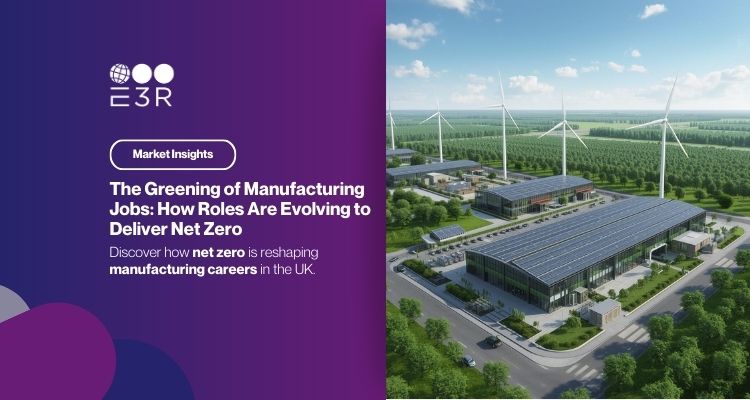
The Greening of Manufacturing Jobs: How Roles Are Evolving to Deliver Net Zero
As the UK moves towards net zero, attention is often placed on new technologies and emerging industries. For manufacturers, however, the reality looks different. The green transition is less about creating entirely new occupations and far more about reshaping the roles that already exist.
Insights from our long-standing partner Make UK highlight that the move to net zero will drive a widespread “greening” of existing jobs. Core occupations such as engineers, technicians, operators, and project professionals remain central to manufacturing.
What is changing is the blend of skills required alongside those foundational capabilities.
Our role is to help manufacturers understand how jobs are shifting, what skills are now critical, and how to attract talent that can support both operational performance and sustainability ambitions.
Evolving Roles Across Manufacturing, Not Replacing Them
The transition to net zero is not removing the need for traditional manufacturing roles. Instead, it is expanding their scope.
Design engineers are increasingly expected to consider energy efficiency, material selection, and lifecycle impact. Maintenance engineers are supporting low-energy equipment, smart monitoring systems, and predictive maintenance technologies. Production and operations professionals are playing a greater part in waste reduction, water efficiency, and process optimisation.
Across E3 Recruitment’s sectors:
- In Aerospace & Defence, engineers are balancing advanced manufacturing with lightweight materials, energy-efficient processes, and sustainable supply chain requirements.
- In Building & Construction Materials, technical and operational teams are working with alternative fuels, lower-carbon materials, and circular economy initiatives.
- In Automotive & Fleet, manufacturing and maintenance professionals are adapting to electrification, battery technologies, and low-emission production methods.
- In Chemical & Process, engineers are combining process safety expertise with energy recovery, emissions monitoring, and decarbonisation projects.
- In Energy & Utilities, technicians and engineers are supporting renewable generation, grid infrastructure, and smart energy systems.
- In Food & Drink, engineers and operations managers are focused on reducing water usage, improving thermal efficiency, minimising food waste, and optimising packaging
- In General Manufacturing, production teams are embedding energy management systems, automation, and data-led optimisation.
- In Oil & Gas, engineers are increasingly involved in carbon capture, hydrogen, alternative fuels, and efficiency-driven asset management.
Job titles often remain familiar. The skill requirements continue to broaden.
The Green Skills Mix: What Employers Now Need
Green capability in manufacturing typically falls into three overlapping areas.
Practical and technical capability
This includes installing and maintaining low-energy equipment, upgrading utilities infrastructure, supporting renewable or alternative energy systems, and improving plant efficiency.
Enabling digital and project skills
Automation, data analytics, and integrated control systems play a major role in reducing emissions and waste. Engineers and managers must be confident using digital tools to monitor and optimise performance.
Systems thinking and environmental understanding
Employees need to understand how decisions affect the wider production chain, from raw materials and utilities through to packaging, logistics, and end-of-life impact.
E3 Recruitment increasingly incorporates these dimensions into candidate assessment alongside core technical competence.
New Roles Emerging Alongside Core Functions
Although most change is happening within existing jobs, some new roles are becoming more common:
- Sustainability or Environmental Engineers
- Energy Managers and Carbon Analysts
- Decarbonisation Project Managers
- ESG and Environmental Compliance Specialists
- Utilities Optimisation Engineers
In Food & Drink, additional growth is being seen in water efficiency, waste reduction, and sustainable packaging-focused positions.
These roles typically work closely with engineering and operations teams, ensuring sustainability strategy translates into practical delivery.
E3 Recruitment supports clients in defining these positions clearly, aligning them with real operational needs rather than purely theoretical objectives.
Why Green Capability Is Now a Commercial Priority
Sustainability is no longer separate from business performance.
Manufacturers are increasingly required to demonstrate environmental progress as part of tendering, customer audits, and supply chain partnerships. Businesses that cannot evidence improvements in carbon, energy, and resource efficiency risk losing future contracts.
At the same time, energy and material efficiency directly affect operating costs and productivity.
From a people perspective, organisations with clear sustainability commitments are more attractive to early-career engineers and technical professionals.
Recruitment therefore becomes a strategic tool in delivering net zero, not simply a hiring function.
Addressing the Green Skills Gap
Demand for green and higher-level technical skills continues to exceed supply. Engineers with electrical, controls, process, and digital capability are particularly scarce.
Manufacturers are competing not only with each other, but also with clean energy, infrastructure, and digital sectors for the same talent pools.
Effective workforce strategies increasingly include:
- Reviewing job descriptions to reflect evolving skill needs
- Identifying which green skills can be developed internally
- Considering transferable experience from adjacent sectors
- Partnering with specialist recruiters who understand sector and technical nuances
E3 Recruitment provides salary benchmarking, market insight, and workforce planning to help manufacturers build realistic and sustainable hiring strategies.
Building a Workforce Ready for Net Zero
The greening of manufacturing jobs is already underway. The engineers, technicians, and operators driving production today will also drive the transition to net zero tomorrow.
We work closely with manufacturers across all eight of our sectors to attract, assess, and secure talent capable of operating in this evolving landscape.
By aligning recruitment strategies with sustainability objectives, businesses can strengthen competitiveness, improve productivity, and build a workforce ready for long-term growth.

